
Retaining wall quotes are confusing for a simple reason: some builders price by the square metre of wall face, others by the lineal metre, and the two are only comparable once you know the height. Add site access, drainage and engineering on top and two quotes for the same wall can differ by thousands. This guide gives you current Sydney rates both ways, shows what the add-ons actually cost, and covers the NSW approval thresholds that catch people out.
Quick answer: A retaining wall in Sydney costs roughly $250 to $1,100 per square metre installed in 2026, or about $230 to $805 per lineal metre at one metre high. Treated pine sits at the bottom of the range, concrete sleepers in the middle, and sandstone or block at the top. A standard 10 metre wall at one metre high runs about $2,875 to $8,050. Walls over 600mm to 1m generally need council approval, and engineering adds $575 to $2,300.
Cost per square metre by material
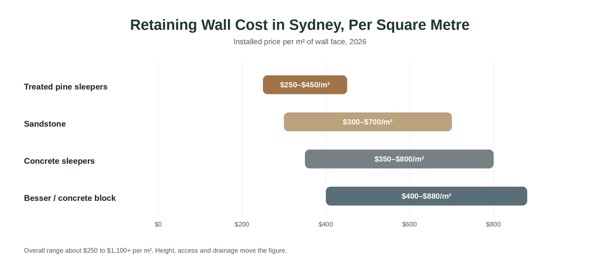
Pricing by the square metre of wall face is the most useful way to compare materials, because it accounts for height. A 10 metre wall at half a metre high is 5 square metres; the same wall at 1.5 metres is 15 square metres and costs roughly three times as much in materials and labour.
| Material | Cost per m² installed | Notes |
| Treated pine sleepers | $250 – $450 | Cheapest upfront; 15–25 year life |
| Sandstone | $300 – $700+ | Premium natural look; slow to lay, so labour-heavy |
| Concrete sleepers | $350 – $800 | Most popular in Sydney; steel posts, low maintenance |
| Besser / concrete block | $400 – $880 | Core-filled and reinforced; suits taller engineered walls |
Cost per lineal metre
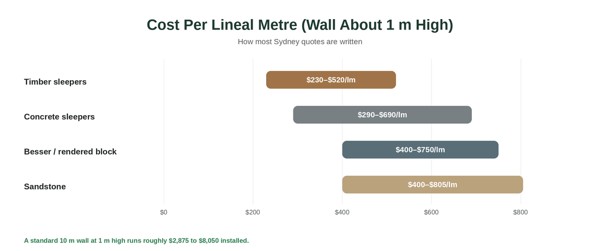
Most Sydney quotes are written per lineal metre, measured along the length of the wall at a stated height. The figures below assume a wall around one metre high, installed with footings.
| Material | Cost per lineal metre (approx. 1 m high) |
| Timber sleepers | $230 – $520 |
| Concrete sleepers | $290 – $690 |
| Besser / rendered block | $400 – $750 |
| Sandstone | $400 – $805 |
Comparing quotes: If one builder quotes per square metre and another per lineal metre, convert before you compare. Multiply the lineal metre rate by the wall height in metres to get the square metre rate, or the other way around. A $600 per lineal metre quote on a 1.5 metre wall is $400 per square metre, which may well be cheaper than a $450 per square metre quote.
What a typical wall costs
Putting the rates together, here is what common residential jobs work out to before engineering, approval or difficult access.
| Wall size | Concrete sleeper | Timber sleeper |
| 5 m long, 1 m high | $1,450 – $3,450 | $1,150 – $2,600 |
| 10 m long, 1 m high | $2,900 – $6,900 | $2,300 – $5,200 |
| 10 m long, 1.5 m high | $5,250 – $12,000 | Not generally suitable |
| 20 m long, 1 m high | $5,800 – $13,800 | $4,600 – $10,400 |
Sydney retaining wall rates rose around 3 per cent in the first quarter of 2026, driven by construction activity and trade shortages, so treat older quotes with caution.
What pushes the quote up
The per-metre rate is only the starting point. These are the add-ons that explain why two quotes for the same wall can look very different.
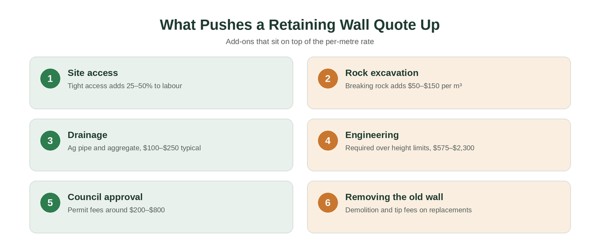
- Site access. If machinery cannot reach the wall, the work is done by hand. Difficult access commonly adds 25 to 50 per cent to labour, and tight side access is normal in older Sydney suburbs.
- Rock and excavation. Breaking rock adds roughly $50 to $150 per cubic metre. Parts of Sydney sit on sandstone shelf, so this is not unusual.
- Ag pipe, aggregate backfill and weep holes typically add $100 to $250 on a residential job, or about $15 to $35 per lineal metre for the drainage line itself.
- Structural design and certification runs $575 to $2,300 once you pass the height threshold.
- Council approval. Permit fees commonly sit between $200 and $800.
- Removing an existing wall. Demolition, cartage and tip fees on a replacement job, which is why replacements often cost more than new builds.
- If underground services need relocating, that can run into thousands on its own.
Cost against lifespan
Comparing walls purely on upfront price hides the real number. A treated pine wall at $250 per square metre that needs replacing in 20 years is not cheaper than a concrete sleeper wall at $450 per square metre that lasts 50, once you account for the rebuild and the disruption.
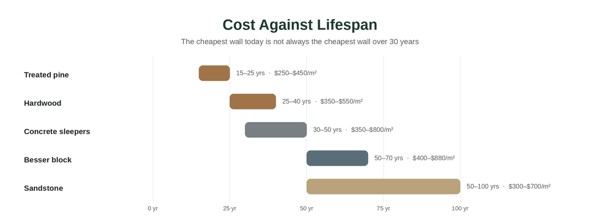
Concrete sleepers are the most popular choice in Sydney precisely because they land in the middle on price and near the top on durability. Sandstone and block cost more upfront but can outlast the house. Timber makes sense for low garden walls, informal settings and shorter time horizons.
Council approval in NSW, and what it costs
NSW has clear rules here, though the thresholds differ between councils. Under the Codes SEPP, a retaining wall can often be built as exempt development when it is no higher than 600mm, sits clear of boundaries, and does not affect drainage to neighbouring properties. Some Sydney councils set the threshold at 800mm.
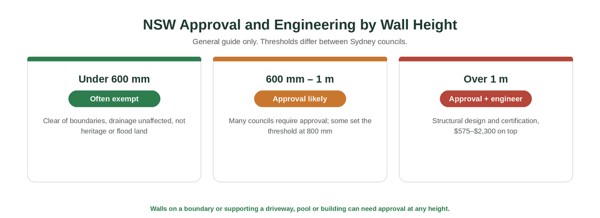
Above those heights you need council approval or a complying development certificate, and walls over one metre almost always need an engineer’s design as well. Walls on a boundary, or supporting a driveway, pool, shed or building, can require approval at any height. Building without approval risks a rectification order and can hold up a future sale, so the few hundred dollars in permit fees is cheap insurance.
Licensing: In NSW, residential building work valued over $5,000 in labour and materials must be done by a contractor licensed with NSW Fair Trading. Most retaining walls exceed that threshold.
Why drainage is the line item you should not cut
Poor drainage causes more retaining wall failures than any other factor. Soil behind a wall holds water, that water exerts pressure, and the pressure works on the wall every time it rains until something gives. A properly built wall drains that water away through an agricultural pipe in aggregate, with weep holes through the face.
On the reactive clay found across much of Sydney, this matters more than it does in sandy soil, because clay holds water rather than shedding it. Drainage is a small share of the total cost and the single biggest determinant of whether the wall is still standing in 20 years. If a quote does not mention it, ask why.
How to get an accurate quote
To compare builders fairly, give each one the same brief and insist on the same level of detail.
- Give them the numbers. Wall length, height at the tallest point, and photos showing site access.
- Flag the site conditions. Slope, soil type, any existing wall, drainage problems, and how close the wall sits to a boundary.
- Ask for an itemised quote. Excavation, footings, drainage, materials, labour, engineering, approval and removal of the old wall, listed separately.
- Confirm the licence and insurance. NSW Fair Trading licence number and public liability cover.
- Compare on scope, not the bottom line. A cheaper quote that omits drainage or engineering is not cheaper, it is incomplete.
Common mistakes
- Comparing quotes in different units. Per square metre and per lineal metre are not interchangeable without the height.
- Accepting a quote with no drainage. It is the cheapest way to guarantee a rebuild.
- Building just over the height threshold. Going from 590mm to 650mm can trigger approval and engineering costs. Sometimes two lower tiered walls are cheaper.
- Choosing on upfront price alone. Lifespan differences of 30 years or more swamp the initial saving.
- Skipping approval. An unapproved structural wall is a problem you inherit at sale time.
How CANDO VIEW can help
Retaining walls sit at the point where landscaping becomes construction. Height, soil, drainage, access and approval all interact, and the difference between a wall that lasts 30 years and one that fails in five is mostly decided before the first sleeper goes in. Can Do View builds retaining walls across Ryde, Eastwood, Carlingford, Epping, North Epping and greater Sydney, and can give you an itemised quote that covers the whole scope rather than a headline rate. Learn more on our retaining walls service page, or get in touch for a quote.
Frequently asked questions
How much does a retaining wall cost per square metre in Sydney?
Expect roughly $250 to $1,100 per square metre of wall face installed in 2026, depending on material and site. Treated pine sleepers sit at about $250 to $450 per square metre, sandstone $300 to $700, concrete sleepers $350 to $800, and besser or rendered block $400 to $880. Height, site access, drainage and engineering all move the figure, so the same material can price very differently on two properties.
How much does a retaining wall cost per lineal metre?
At around one metre high, Sydney rates run about $230 to $520 per lineal metre for timber sleepers, $290 to $690 for concrete sleepers, $400 to $750 for besser or rendered block, and $400 to $805 for sandstone. Most quotes are written this way. A standard 10 metre wall at one metre high typically lands between about $2,875 and $8,050 installed, before any engineering or approval costs.
What is the cheapest type of retaining wall?
Treated pine sleepers are the cheapest upfront, from around $250 per square metre or $230 per lineal metre installed. The trade-off is lifespan: treated pine generally lasts 15 to 25 years, while concrete sleepers last 30 to 50 and sandstone or block can last 50 to 100 years. If you plan to stay long term, the cheapest wall today often is not the cheapest wall across three decades once a rebuild is factored in.
How much does a concrete sleeper retaining wall cost in Sydney?
Concrete sleepers typically cost $350 to $800 per square metre, or about $290 to $690 per lineal metre at one metre high. They are the most popular residential choice in Sydney because galvanised steel posts and reinforced sleepers give a 30 to 50 year life with almost no maintenance. Textured and decorative finishes sit at the top of the range.
Do I need council approval for a retaining wall in Sydney?
Often, yes. As a general guide, a wall under 600mm that sits clear of boundaries and does not affect drainage to neighbouring properties can be exempt development in NSW. Above that, most Sydney councils require approval, and some set the threshold at 800mm. Walls over one metre almost always need approval plus a structural engineer’s design. Walls on a boundary, or supporting a driveway, pool or building, can need approval at any height. Check with your local council before you start.
How much does engineering and council approval add?
A structural engineer’s design and certification typically costs $575 to $2,300 depending on the wall, and council permit fees commonly run $200 to $800. These are real budget items rather than optional extras once you pass the height threshold. They also protect you, since an unapproved wall can attract a rectification order and can complicate a future sale.
Why does drainage matter so much in a retaining wall quote?
Poor drainage is the leading cause of retaining wall failure. Water building up behind a wall creates pressure that timber, block or stone cannot resist indefinitely, and the wall bulges, cracks or collapses. Proper drainage means an agricultural pipe, aggregate backfill and weep holes, which usually adds around $100 to $250 on a typical residential job, or roughly $15 to $35 per lineal metre for the ag line. Any quote that leaves drainage out is not comparable to one that includes it.
Do I need a licensed builder to build a retaining wall in NSW?
For most walls, yes. In NSW, residential building work valued over $5,000 in labour and materials must be carried out by a contractor licensed with NSW Fair Trading, and the majority of retaining wall projects exceed that. Using a licensed contractor also matters for insurance, warranty and council sign-off, so confirm the licence before you accept a quote.