
Neither option wins every time. Pavers suit sites that move, sites that drain badly, and jobs where the finished look carries the most weight.
Poured concrete suits long open runs, heavy vehicles and a clean, quiet surface with nothing to trip on. In Sydney the honest answer comes down to three things. Your ground, your drainage, and how you want the space to age.
Pavers cost more to lay, but a damaged one lifts out in an hour and goes back looking new.
Concrete goes down faster and asks less of you later, although a serious crack usually means saw cutting and pouring a fresh panel.
Here is how the two compare on a real Sydney block.
Key Takeaways
- There is no single winner. Both surfaces perform well when they are built properly. The right pick depends on your site, not on fashion.
- Concrete is usually cheaper to lay. Pavers cost more up front because the units are dearer and the work is much slower.
- Pavers are far easier to repair. You lift the damaged ones and re-lay them, while a cracked slab often has to be cut out and poured again.
- Concrete cracks and pavers settle. Both faults trace back to the same place, because a weak base will eventually ruin either surface.
- Pavers handle water better. Rain can pass down through the joints, while concrete sheds all of it and needs proper falls and a drainage plan.
- You wait about a week before driving on new concrete. Pavers can carry a car within a day or two of the last unit going down.
- A new driveway crossing in Sydney needs council approval. The work between your boundary and the kerb sits under the Roads Act 1993.
What Pavers Are, and How They Go Down
Pavers are individual units laid over a prepared base, and they can be made from concrete, clay, natural stone or porcelain.
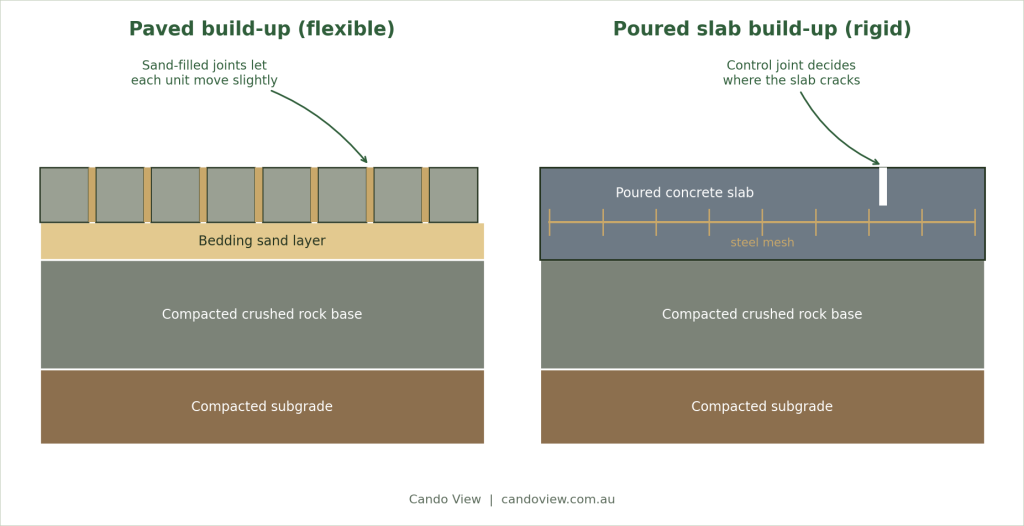
The build-up underneath matters far more than the paver you choose. The crew digs out the ground first, then a layer of crushed rock goes in and is compacted hard. A thin bedding layer of sand sits on top of that. The pavers then go down one at a time. Sand is swept into the joints, and the whole surface is compacted again.
That sand joint is the whole point of the system, because it lets each unit shift a hair without breaking. A solid slab cannot do that.
A paved driveway also needs a deeper base than a patio does. A patio carries people and a table, while a driveway carries a two tonne vehicle every day of the year. Both start with the same excavation and site preparation work.
Quick takeaway: pavers are a flexible system. The base and the joints do as much work as the stone you can see.
What Poured Concrete Is, and How It Goes Down
Poured concrete is a single slab, formed and poured in place on the day.
The job starts the same way. The crew digs out, grades the ground and lays a compacted base, then sets timber or steel forms to hold the shape. Steel mesh goes in for strength, and the concrete is poured, screeded, finished and left to cure.
Control joints are cut or tooltied into the surface as planned weak lines. Concrete shrinks as it cures and will crack somewhere, so a good crew decides in advance where those cracks will land.
The finish is chosen at the pour and cannot be changed afterwards. Plain grey, broom finish, exposed aggregate, honed and coloured concrete are all options worth asking your concreting contractor about.
Quick takeaway: concrete is a rigid system, so its strength comes from the mix, the reinforcement and the joints rather than from movement.
Pavers vs Concrete at a Glance
| What you are comparing | Pavers | Poured concrete |
| Up-front cost | Higher. Slower to lay and the units cost more. | Usually lower for the same area. |
| Look and choice | Wide range of sizes, colours and laying patterns. | Grey by default. Colour, stamping and exposed aggregate widen it. |
| Repairs | Lift the damaged units and re-lay them. The fix hides well. | Patch or saw cut and re-pour. New concrete rarely matches old. |
| Cracking | Units rarely crack. The joints absorb small movement. | Cracking is normal. Control joints steer where it lands. |
| Water | Some rain passes through the joints, which slows runoff. | Sheds all of it. Needs correct falls and a real drain. |
| Weeds | Possible if the joint sand washes out. | No joints, so almost none. |
| Ready to use | A day or two after the last unit goes down. | About 7 days for a car. About 28 days for heavy loads. |
| Upkeep | Top up joint sand. Wash. Seal if you want. | Watch cracks and joints. Wash. Seal decorative finishes. |
| Best suited to | Patios, courtyards, paths, sloping and reactive sites. | Long driveways, large slabs, heavy or constant traffic. |
Cost: Which One Is Best?
Concrete usually costs less to lay, because a pour covers a large area quickly and the crew is on site for fewer days.
Pavers cost more. Every unit is placed by hand, and the base under a paved driveway is often deeper than the base under a slab.
That gap narrows as soon as you add a decorative finish. Coloured, stamped and exposed aggregate concrete all cost more than plain grey. At the top end, a decorative slab can land close to a paved job.
The long view can flip the order completely. Pavers are cheap to repair and concrete is not. If a plumber has to dig up a service line, the pavers come up and go straight back. A slab in the same spot has to be cut and poured again.
We do not quote over the phone. Access, soil, levels and drainage all change the number, so Cando View gives a quote after an on-site assessment.
Quick takeaway: concrete tends to win on day one, while pavers tend to win on year ten.
How Each One Handles Sydney Ground
The ground is the part of the job you never see, and it decides most of the outcome.
Sydney soil is not one thing. Parts of the north-west sit on shale clay that swells when it gets wet and shrinks when it dries out again. Other blocks sit on sandstone with rock close to the surface. Two houses in the same street can behave in completely different ways.
Clay that moves is hard on a slab. A slab is rigid, so ground movement tends to show up as a crack. Pavers ride the same movement, because each unit can shift a little.
Big trees add to the problem. Roots will lift slabs and pavers alike. The difference is that a lifted paver can be taken up, the root dealt with, and the paver put back the same day.
You will read a lot online about freeze and thaw damage, and you can ignore it here. That is a northern hemisphere problem. Sydney does not freeze, so our real issues are clay movement, summer heat, tree roots and heavy downpours.
None of this rules out concrete. It means the base and the reinforcement have to suit the ground you actually have. That is what a site visit establishes, and it is the same thinking that goes into a retaining wall on a sloping block.
Quick takeaway: on reactive ground pavers are more forgiving, although a properly designed slab still performs well.
Drainage: Where Does the Water Go?
Most homeowners skip this part, and it causes more grief later than anything else on the job.
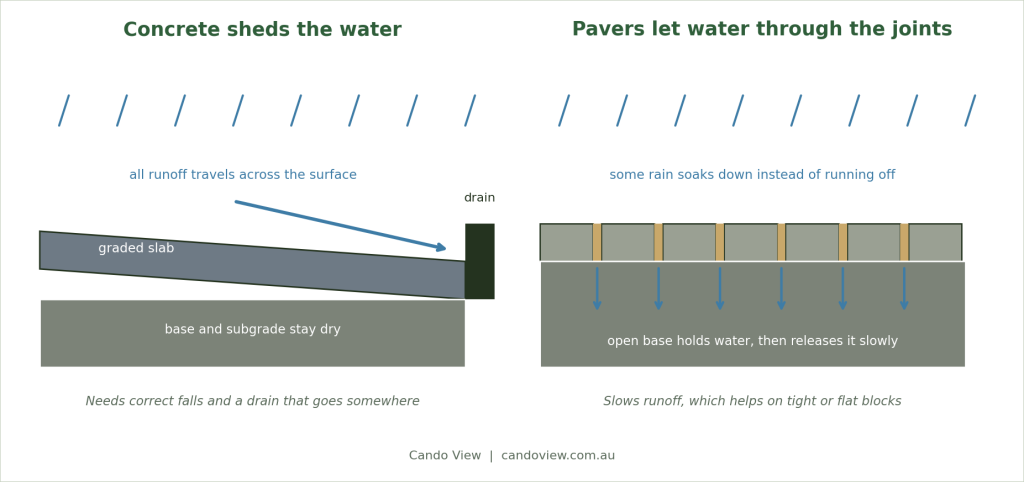
Concrete sheds water, all of it. The slab has to be graded so water is sent somewhere useful, and that somewhere has to be a real drain. Get the fall wrong and you end up with puddles, or with water running back towards the garage door.
Pavers let some water through the joints, so a standard paved surface slows the runoff. Permeable pavers go further still. They use wider joints, clean angular stone inside those joints and an open graded base. Water soaks down through the surface instead of running off it.
That distinction matters in Sydney. Councils set rules on where driveway water goes, and runoff normally has to be directed into the existing stormwater system rather than onto a footpath or a neighbour’s land. They also take an interest in how much of a block is covered by hard surface.
On some sites the water has to be held back and released slowly, which is what an on-site detention tank does. Cando View builds stormwater and OSD systems as part of the same job. The surface and the drainage get designed together rather than in sequence.
Quick takeaway: choose the surface and the drainage at the same time, because adding drainage to finished paving later is costly.
Repairs: What Happens When Something Goes Wrong
Nothing outdoors stays perfect forever, so what really matters is how easy the eventual fix will be.
A cracked paver comes out with two screwdrivers. You lift it, sort out the base underneath, and put it back, and the repair all but disappears.
A cracked slab is much harder. Small cracks can be filled, but the filler shows, and a serious crack means saw cutting the panel and pouring a new one. Fresh concrete rarely matches weathered concrete, so the patch stays visible for years afterwards.
The same logic applies to underground services. Pavers can be lifted for a pipe and then re-laid, while a slab simply gets cut open.
Quick takeaway: with pavers you repair a square metre, and with concrete you usually replace a whole panel.
Looks: Which One Suits Your Home?
Pavers win comfortably on choice. Sizes, colours, shapes and laying patterns all change the finished look. You can run a border in a second colour. You can also match the paver back to the brickwork on the house, which is a common request on our paving and hardscaping jobs.
Concrete has come a long way, and plain grey is only one option among many. Exposed aggregate reveals the stone in the mix. Stamped concrete is pressed while wet so it reads as stone or timber. Colour can be added through the mix or applied to the surface.
Concrete tends to look calm and modern, while pavers look detailed and textured. Neither one is better on its own. Look at your own house and garden rather than at a photo of someone else’s backyard, and browse a few finished projects before you decide.
Quick takeaway: match the surface to the house, because both materials can look excellent or look badly out of place.
Maintenance: What Each One Asks of You
Both surfaces need a wash now and then. After that, what they ask of you differs.
With pavers, the job is keeping joint sand topped up. Sand washes out over the years, and empty joints let weeds establish and let individual units wander. A polymeric sand helps a lot. Sealing is optional. It lifts the colour and makes stains easier to shift.
With concrete, the job is watching the control joints and any cracks, and filling them before water gets underneath. A decorative finish should be sealed to protect the colour. Oil sits on the surface and usually lifts with a degreaser.
Neither option is maintenance free, and anyone who tells you otherwise has probably never owned one.
Quick takeaway: pavers ask for joint sand, while concrete asks for crack care and sealing.
How Long the Job Takes, and When You Can Use It
Pavers take longer to build, because there is more hand work involved and the base often has to be deeper.
Concrete is quicker to build and then slower to use, and that second half is the part people forget to plan for.
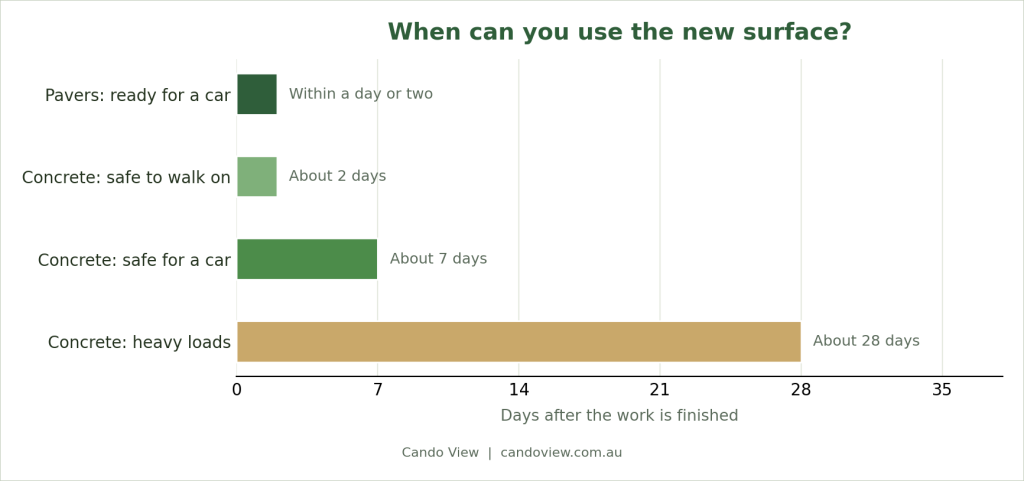
Fresh concrete needs time. General guidance is roughly seven days before a car goes on it. Heavy loads such as a caravan or a truck should wait around 28 days. Hot Sydney weather does not speed any of that up. It simply means the slab needs closer attention while it cures.
Pavers do not cure at all. Once the joints are sanded and the surface has been compacted, it can carry traffic. If the driveway you are rebuilding is the only one you have, that difference is worth planning around.
Quick takeaway: concrete is built faster but takes a week off the road, while pavers take longer to build and are usable immediately.
Council Approval for a Driveway in Sydney
This is the point that catches most homeowners out.
The strip between your boundary and the curb is not yours, because it belongs to the council. Building or altering a vehicle crossing there needs approval from the roads authority under Section 138 of the Roads Act 1993.
Approval for a house, garage or carport does not cover that work. It is a separate application to your council.
Councils also set the standards for the crossing itself. Ku-ring-gai, for example, issues driveway levels first and requires a formwork inspection before anyone is allowed to pour. The rules differ from one council to the next, so confirm yours before a concrete truck gets booked.
Inside your own boundary a patio or a rear yard slab is usually far simpler. Even then, hard surface area, levels and drainage can still bring rules into play, so ask first and build second.
Quick takeaway: the surface is entirely your choice, but the crossing at the kerb is the council’s decision.
Which One Suits Your Project?
| If this sounds like you | Better starting point | Why |
| Sloping or clay-heavy block that already moves | Pavers | Joints absorb small movements without cracking. |
| Long straight driveway and a tight budget | Concrete | Faster over a large area and cheaper to lay. |
| Water already pools in the yard | Pavers, or concrete with a drainage plan | Joints let water through and slow the runoff. |
| Caravan, boat trailer or a work truck | Concrete with the right base and mesh | A continuous slab spreads heavy loads well. |
| You need the driveway back in use fast | Pavers | There is no curing period to wait out. |
| Pipes or services run under the area | Pavers | They lift out for a dig and go back afterwards. |
| You want a clean, modern, low-fuss surface | Concrete | No joints to top up and nothing to trip on. |
| Colour, pattern and detail matter to you | Pavers | Far more choice in size, colour and layout. |
The Part That Decides Both
Here is what years on site teach you. Most failed paving and most failed slabs are base failures rather than surface failures.
Pavers sink because the sub-base was too thin or was never compacted properly. Slabs crack badly for similar reasons. The ground beneath them moved, or the mesh sat in the wrong place, or the control joints were never cut.
None of that is visible on handover day. You see it three years later, once the ground has been through a few wet and dry cycles.
So ask every quote what actually goes under the surface. How deep is the excavation? What base material is used, and to what thickness? Where does the water go? A quote that answers those questions is a quote you can genuinely compare against another.
Why Sydney Homeowners Call Cando View
Cando View has built outdoor spaces around Sydney since 2019, and the trade experience behind the business goes back to 2007. We handle excavation, paving, concreting, retaining walls, fencing and full landscape construction with our own crew.
That counts for a lot on a job like this one. A driveway is rarely just a surface. There is an excavation, a base, levels, drainage and often a crossing built to council spec. Using one team means no gaps between trades, and one person to call.
We work across Ryde, Eastwood, Carlingford, Epping and North Epping, and through the wider north-west including Castle Hill, Baulkham Hills and Parramatta.
We quote after we have seen the site. Book an on-site assessment, or call us on 0424 240 674 to talk the project through.
Frequently Asked Questions
1. Are pavers better than concrete for a driveway?
Not always. Pavers handle ground movement and repairs better, while concrete handles heavy loads and large open areas well and costs less to lay. The right pick depends on your soil, your slope and how the driveway will actually be used.
2. Which is cheaper, pavers or concrete?
Concrete is usually cheaper up front for the same area, because pavers cost more to buy and considerably more to lay. Over a longer period, easy repairs can close some of that gap again.
3. How long before I can drive on a new concrete driveway?
General guidance is about seven days for a car and around 28 days for heavy loads. Your concreter should give you exact timing for your slab, the mix used and the weather on the day.
4. Do pavers get weeds?
They can, if the joint sand washes out of the surface. Topping the sand up and using a polymeric sand keeps most weeds away, and sealing the surface helps as well.
5. Do I need council approval for a new driveway in Sydney?
For the crossing between your boundary and the kerb, yes. That work needs approval from the roads authority under the Roads Act 1993. Forms and standards differ by council, so check with yours directly.
6. Which is better for drainage, pavers or concrete?
Pavers, in most cases. Water can move down through the joints, and permeable pavers are built specifically to soak it away. Concrete can perform well too, but only with correct falls and a drain that actually goes somewhere.
7. Can you lay pavers over an existing concrete slab?
Sometimes. It depends on the condition of the slab, the existing falls, and how much extra height you can add at doorways and steps. It needs a look on site before anyone promises it will work.
8. How long do pavers and concrete last?
Both can last for decades when they are built properly. The base, the drainage and the standard of the work matter far more than the material you choose.