
Most comparisons of these two read like a scorecard where one side was always going to win. The real answer is narrower and more useful. Natural turf and artificial grass are both the right call on some Sydney blocks and the wrong call on others, and three things decide it: how much direct sun the area gets, whether you mow it yourself, and what your council’s controls say about permeable area.
This guide works through all three with Sydney numbers, including a fifteen year cost comparison you can adjust for your own yard.
Quick answer:
If you mow it yourself, natural turf is cheaper than artificial grass over any timeframe and runs around $3,450 against $14,250 over fifteen years on a 60 m² yard. If you pay a contractor to mow, artificial grass pays for itself in about four years. Natural turf is cooler underfoot, counts as landscaped area and drains into soil. Artificial grass wins in deep shade, where turf will not hold a cover below about three hours of direct sun a day. The decisive catch is heat: Western Sydney University measured artificial turf at 89.2 °C on a 28 °C Sydney day, hot enough to burn skin and paw pads.
Key Takeaways
- Natural turf costs $25 to $45 per m² installed in Sydney. Artificial grass runs $83 to $125 per m² installed.
- Who mows decides the money. DIY mowing makes natural turf cheapest on any timeline; a mowing contract flips it inside four years.
- Artificial grass was measured at 89.2 °C on a 28 °C Sydney day. Surfaces above about 50 °C can burn on contact.
- Below roughly three hours of direct sun a day, no turf variety holds a dense cover. That is where artificial earns its place.
- Artificial grass sits on a compacted base, so it is not deep soil and generally will not count towards landscaped area.
- City of Ryde requires 35 per cent of the allotment as deep soil, including an 8 m by 8 m area in the back yard.
- Artificial grass lasts 8 to 15 years, then has to be lifted and sent to landfill. There is no established recycling stream in Australia.
The honest head-to-head
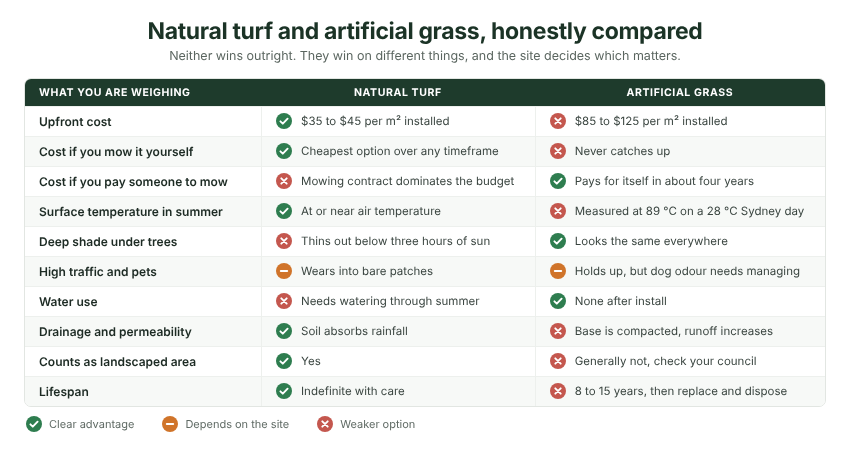
Note how the pattern splits. Natural turf takes cost, comfort, drainage and planning. Artificial grass takes shade, water and consistency of appearance. Neither list is short, which is why a blanket recommendation is usually wrong.
Is it cheaper to turf or artificial grass?
This is the most searched question on the topic and almost nobody answers it with numbers. Here is the model, worked on a 60 m² back yard over fifteen years.
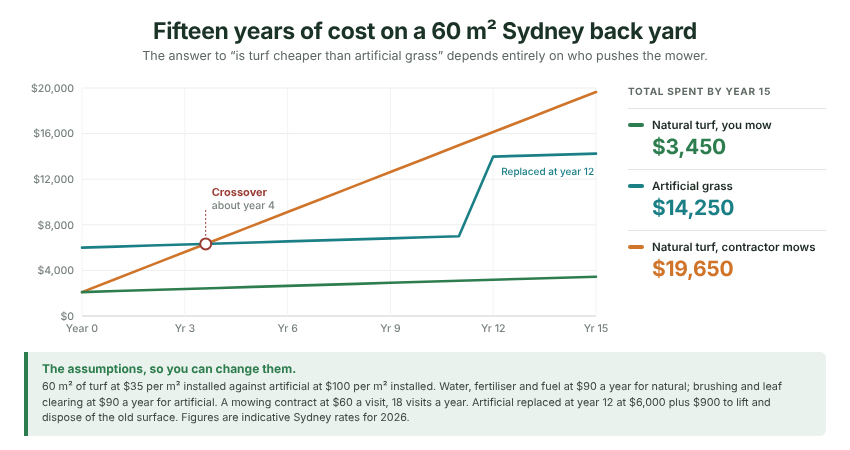
What the chart shows
- Natural turf, you mow it: $3,450 over fifteen years. Installation is the bulk of it. Water, fertiliser and fuel run around $90 a year on a yard this size.
- Artificial grass: $14,250 over fifteen years. Most of that is the install, plus a replacement at year twelve costing another $6,000 and about $900 to lift and dispose of the old surface.
- Natural turf, a contractor mows it: $19,650 over fifteen years. At $60 a visit and 18 visits a year, the mowing contract alone is $1,080 annually, which dwarfs everything else.
So the answer depends entirely on who pushes the mower. Against DIY mowing, artificial grass never catches up. Against a mowing contract, it crosses over at about year four and stays ahead until the replacement resets the clock.
The pattern worth noticing: the smaller the yard, the stronger the financial case for artificial grass, because a mowing contractor charges per visit rather than per square metre. A 40 m² courtyard costs almost as much to mow as a 120 m² yard, so the cost per square metre of mowing is far higher on small areas. If you have a small yard and you already pay someone to mow, artificial grass is a reasonable financial decision. If you have a large yard and a mower in the shed, it is not.
Indicative Sydney costs, 2026
| Item | Range | Notes |
|---|---|---|
| Natural turf, supply and lay | $25 to $45 per m² | Sir Walter buffalo supply is around $14 per m²; the rest is prep, levelling and laying |
| Artificial grass, supply only | $33 to $55 per m² | Mid-range grade lasting 8 to 12 years; premium is $55 to $100 |
| Artificial grass, installed | $83 to $125 per m² | Includes excavation and base construction on a moderate site |
| Clay or sandy subsoil | add $5 to $15 per m² | Extra base work under artificial grass |
| Removing existing concrete | $20 to $40 per m² | Before either surface goes down |
| Restricted access | add $200 to $500 | Where there is no standard 900 mm gate |
| Mowing contract | $50 to $80 a visit | Roughly 18 visits a year in Sydney, fortnightly in the growing season |
Site preparation is the variable that moves artificial grass pricing most, because it is a civil job before it is a surface. Clay subsoil, tree roots and poor fall all push it into a higher bracket. That groundwork is excavation work in its own right, and it is worth pricing separately so you can compare quotes properly.
The heat problem
This is the factor that changes people’s minds, and the published figures understate it.
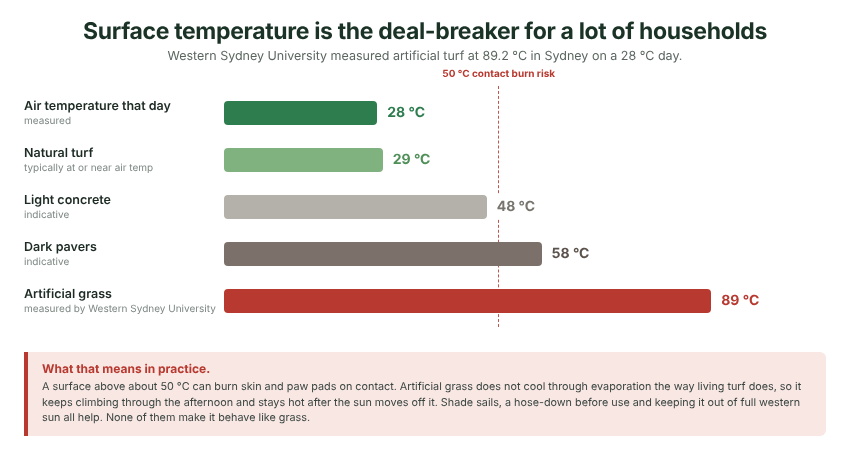
Living turf cools itself. Water moving through the plant and evaporating from the leaf keeps the surface at or near air temperature, which is why grass feels cool underfoot on a hot day and concrete does not. Artificial grass has no such mechanism. It absorbs solar radiation and re-radiates it, and it keeps climbing through the afternoon.
A surface above roughly 50 degrees can burn skin and paw pads on contact. At 89 degrees you are well past that. The practical consequences are a back yard that is unusable barefoot through summer afternoons, dogs that will not walk on it, and a heat load against the back of the house at exactly the time of day you least want one.
Mitigation helps, but only so far. Shade sails over the area, hosing it down before use, and keeping artificial grass out of full western sun all reduce the peak. None of them make it behave like living turf. If the area gets strong afternoon sun and children or pets use it, that is a reason to think hard before committing.
Start with sun hours, not preference
Here is the measurement that should drive the decision, and it takes one afternoon to make.
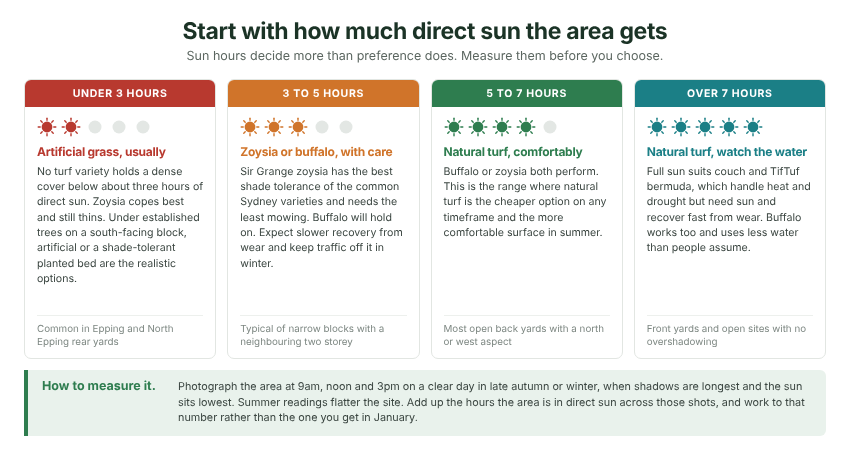
How to measure it properly
Photograph the area at 9am, noon and 3pm on a clear day in late autumn or winter, when the sun sits lowest and shadows are longest. Add up the hours the area sits in direct sun. Summer readings flatter a site badly, because the sun is high enough to clear the fence and the neighbour’s roofline in a way it will not in July.
Which turf variety suits which position
| Variety | Best for | What to know |
|---|---|---|
| Sir Grange zoysia | Shade down to about 3 hours | The best shade tolerance of the common Sydney varieties, and the lowest mowing frequency. Costs more to buy and is slower to repair |
| Buffalo, Sir Walter and similar | The general-purpose choice | Handles 4 hours of sun upward, good wear recovery, broad leaf. The default for most Sydney back yards |
| TifTuf bermuda | Full sun, heat and drought | Excellent drought performance and fast recovery from wear, but needs strong sun and goes off colour in winter |
| Couch | Full sun on a budget | Cheapest to buy at around $10 per m², fine in open positions, poor in shade |
| Kikuyu | Hard-wearing, open sites | Cheap and vigorous, which is also the problem. It invades planting beds and neighbouring yards |
If the area genuinely sits under three hours of sun, be honest about it. Laying turf there and watching it thin out over two seasons is the most common way money gets wasted on a Sydney back yard. Artificial grass, a shade-tolerant planted bed, or a paved or decked area are the three options that actually work, and our guide to low maintenance ideas for Sydney yards covers the planted alternatives.
What sits underneath each one
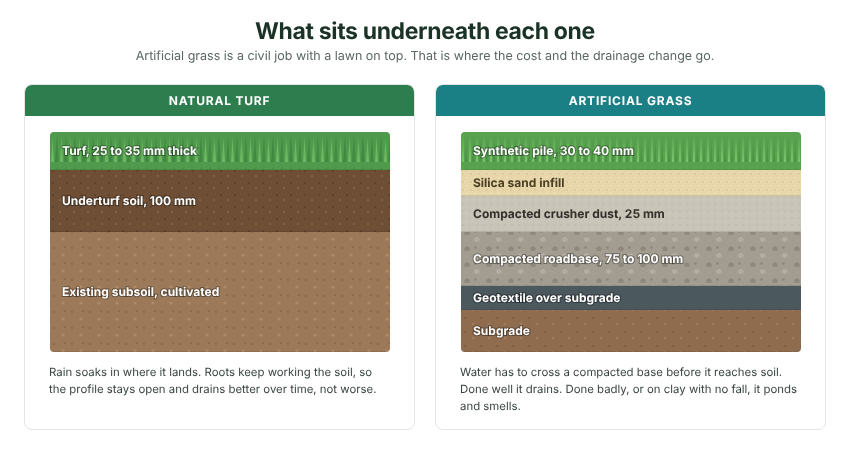
This section explains most of the cost difference and all of the drainage difference. Natural turf is laid onto cultivated soil with a layer of underturf mix. Rain soaks in where it lands, and the root system keeps working the profile so it drains better over time rather than worse.
Artificial grass needs a compacted roadbase, usually 75 mm to 100 mm, topped with crusher dust screeded to a fall, geotextile over the subgrade, and silica sand infill brushed into the pile after laying. Done properly it drains through the backing and across the base to a discharge point. Done badly, or on reactive clay with no fall, water sits in the base, the surface stays damp and odour becomes a problem, especially where dogs use it.
Dogs are the detail people underestimate
Artificial grass handles dog traffic better than turf, which is the usual reason people choose it. The trade-off is urine. It drains through the pile into the base rather than being broken down by soil biology, so without regular rinsing and an enzyme treatment the smell builds up, and it builds up fastest in exactly the warm weather that makes the surface unpleasant anyway. Specify a permeable backing, a free-draining base and a connection to stormwater, and plan on rinsing it down regularly.
The planning question nobody asks until it is too late
This is the part that catches homeowners, and in Cando View’s service area the numbers are specific enough to check before you commit.
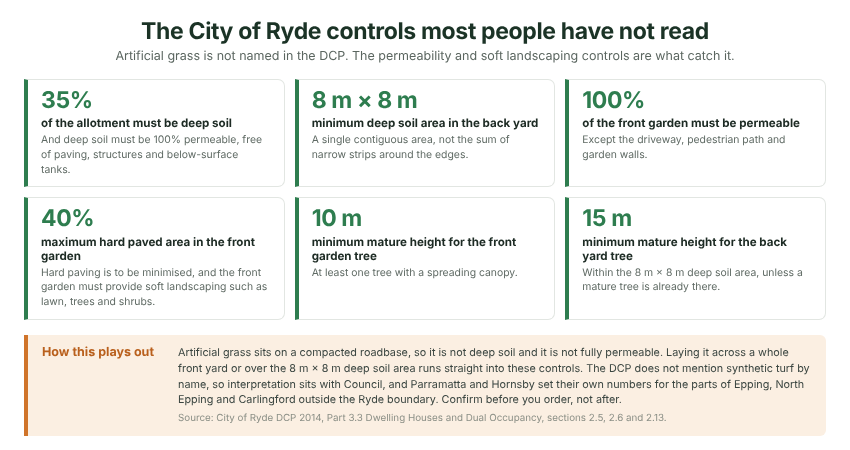
City of Ryde requires a deep soil area of at least 35 per cent of the allotment, including a single area of at least 8 metres by 8 metres in the back yard. Deep soil must be 100 per cent permeable and free of paving, structures and below-surface tanks. The front garden must be completely permeable except for the driveway, path and garden walls, hard paved areas are capped at 40 per cent of the front garden, and the front garden must provide soft landscaping such as lawn, trees and shrubs.
The DCP does not name synthetic turf, so interpretation sits with Council. But artificial grass is laid on a compacted roadbase, which is neither deep soil nor fully permeable. Laying it across a whole front yard, or over the 8 by 8 metre deep soil area, runs directly into those controls.
Three councils, three rule sets. Cando View’s service area spans more than one council. Ryde covers much of Ryde and Eastwood, while parts of Epping, North Epping and Carlingford fall under City of Parramatta or Hornsby Shire, each with their own numbers. Check the controls for your actual address before ordering, not after.
Drainage and stormwater
There is a second planning consequence. Replacing soil with a compacted base changes how much rainfall your site absorbs, which affects the site’s impervious area calculation. On a block already close to its limit, or one subject to on-site detention requirements, that matters. If you are covering a large area, it is worth resolving as a stormwater and detention question before the base goes in. Our explainer on stormwater and OSD sets out how those systems work and when they are triggered.
What is the downside to artificial turf?
- Heat. The single biggest one. 89 degrees on a 28 degree day, and it stays hot after the sun moves off.
- End of life. 8 to 15 years, then it has to be lifted and disposed of. There is no established recycling stream for it in Australia, so it goes to landfill, and removal is a cost on top.
- It does not improve. The pile flattens in traffic lanes, the colour fades in UV, and seams can lift. It looks its best on day one and declines from there. Natural turf goes the other way with care.
- Odour where pets use it. Manageable with drainage and rinsing, but it is real and it is worst in summer.
- No soil life, no cooling, no habitat. A sealed base under plastic supports nothing. On a small urban block this matters more than it sounds, because it is usually the only soft ground left.
- Weeds still appear. Seeds germinate in the organic matter that collects in the pile, exactly as they do in stone. It needs clearing out, not never touching.
- Microplastic shedding. The pile and the infill break down over the surface’s life and wash into stormwater. The research on this is still developing and the picture is not reassuring.
What makes artificial grass look realistic
Worth answering by specification rather than brand, because brands change and specs do not.
- Pile height 30 mm to 40 mm. Shorter looks like carpet. Longer flattens and looks matted in traffic.
- Multi-tone yarn with a brown thatch layer. Real lawn is not one colour. A product with two or three greens plus a brown underlayer reads far better than a flat green.
- Varied blade shapes and a stem rib. Blades with a spine stand up rather than lying over, which is what stops the matted look.
- Density above about 16,000 stitches per square metre. Sparse products show their backing, especially on a slope where you see the surface at an angle.
- Non-directional pile if you can get it. Directional pile looks obviously different depending which way you walk round it.
- Sand infill, brushed in properly. It is what holds the blades upright. Skipping or skimping on infill is the most common reason a good product looks cheap after a year.
Most of what separates a convincing installation from an obvious one is the install rather than the product. Straight seams, a true screeded base, a clean edge detail and properly brushed infill matter more than the extra ten dollars a square metre on the roll.
So which should you choose?
- Under three hours of direct sun, with pets or kids. Artificial grass, with shade over it if the position gets afternoon sun. Turf will not survive there.
- Under three hours of sun, no pets. Consider skipping grass entirely. A planted bed, paving or decking suits a shaded area better than either option. Our comparison of pavers and concrete covers the hard surface route.
- Four hours or more, and you own a mower. Natural turf, comfortably. It is cheaper on any timeframe, cooler, and it counts towards your landscaped area.
- Four hours or more, small yard, you pay someone to mow. Artificial grass is a defensible financial decision, provided the area is not in full western sun.
- A front yard in the City of Ryde or similar. Natural turf, or turf plus planting. The permeability and soft landscaping controls make a fully synthetic front yard a planning problem.
- A large back yard with good sun. Natural turf. Artificial grass at 100 dollars a square metre across 150 square metres is $15,000 that buys you a hotter surface.
Getting it done properly
Either surface lives or dies on the preparation. Turf laid onto compacted clay with no cultivation will struggle regardless of variety, and artificial grass over a base that was not screeded to a fall will pond and smell within two summers.
Cando View handles both, from site preparation and excavation through to the finished surface, as part of our landscaping and hardscaping work across Ryde, Eastwood, Epping, North Epping and Carlingford.
You can see finished yards on our projects page. If you want a straight recommendation for your own block, get in touch and we will check the sun hours, the fall and the council controls before suggesting one. There are more ideas for reworking a yard in our guide to upgrading any yard and our modern landscaping solutions, and if you are collecting quotes, our advice on choosing a landscaper in Sydney covers what to check first.
Frequently asked questions
Is it cheaper to turf or artificial grass?
It depends on who mows. On a 60 m² Sydney back yard over fifteen years, natural turf you mow yourself costs around $3,450, artificial grass around $14,250 including a replacement at year twelve, and natural turf with a mowing contractor around $19,650. So if you mow it yourself, natural turf is cheaper over any timeframe. If you pay a contractor roughly $60 a visit, artificial grass pays for itself at about year four. The financial case for artificial grass is strongest on small yards, because a mowing contractor charges per visit rather than per square metre.
Which is better, artificial grass or turf?
Neither is better in general. Natural turf wins on cost if you mow it, on surface temperature, on drainage, and on counting towards council landscaped area requirements. Artificial grass wins in deep shade where no turf variety will hold a cover, on water use, and on consistency of appearance. The deciding measurement is direct sun hours. Below about three hours a day, artificial grass is usually the realistic choice. Above four hours, natural turf is almost always the better one.
What is the downside to artificial turf?
Heat is the biggest. Western Sydney University measured artificial turf at 89.2 degrees on a 28 degree Sydney day, and surfaces above about 50 degrees can burn skin and paw pads. Beyond that, it lasts 8 to 15 years and then has to be lifted and sent to landfill with no established recycling stream in Australia. It flattens and fades rather than improving with age, it holds pet odour without regular rinsing, it supports no soil life, weeds still germinate in the debris that collects in the pile, and it sheds microplastics over its life. It also sits on a compacted base, so it generally will not count towards council landscaped area or permeability requirements.
What is the most realistic artificial grass available in Australia?
Judge it by specification rather than brand. Look for a pile height of 30 mm to 40 mm, multi-tone yarn with a brown thatch layer rather than a single flat green, blades with a stem rib so they stand up instead of lying over, density above roughly 16,000 stitches per square metre, and non-directional pile if available. Most of what separates a convincing installation from an obvious one is the install itself, though. Straight seams, a base screeded true to a fall, a clean edge detail and properly brushed sand infill matter more than the last ten dollars per square metre on the roll.
Does artificial grass count as landscaped area in Sydney?
Generally not. Most NSW councils define landscaped area as ground used for growing plants, and artificial grass sits on a compacted roadbase, so it is neither deep soil nor fully permeable. City of Ryde requires a deep soil area of at least 35 per cent of the allotment, including a single 8 metre by 8 metre area in the back yard, and requires deep soil and the front garden to be permeable. The DCP does not name synthetic turf, so interpretation sits with Council, and Parramatta and Hornsby set their own numbers for parts of Epping, North Epping and Carlingford. Check your address before ordering.
How many hours of sun does natural turf need in Sydney?
Four hours of direct sun a day is a workable minimum for most varieties, and more is better. Sir Grange zoysia has the best shade tolerance of the common Sydney varieties and can hold on at around three hours, though it will be slower to recover from wear. Below three hours, no turf variety maintains a dense cover and it will thin out over a season or two. Measure sun hours in late autumn or winter when shadows are longest, because a summer reading will flatter the site.
How long does artificial grass last in Sydney?
Budget products last five to seven years, mid-range products eight to twelve, and premium products twelve to fifteen or more. Sydney’s UV exposure is at the harsher end, and areas in full afternoon sun fade and flatten faster than shaded ones. At the end of its life it has to be lifted and disposed of, which is a cost on top of replacement, and there is no established recycling stream for it in Australia.
Which turf variety is best for Sydney?
For most Sydney back yards, a buffalo such as Sir Walter is the sensible default, handling four hours of sun upward with good wear recovery. Sir Grange zoysia is the pick where shade is the problem, with the best shade tolerance and the lowest mowing frequency, at a higher purchase price. TifTuf bermuda suits full sun and handles heat and drought well but goes off colour in winter. Couch is the budget option for open positions. Kikuyu is cheap and hard-wearing but invades planting beds and neighbouring yards, which is why many landscapers avoid it on small blocks.